
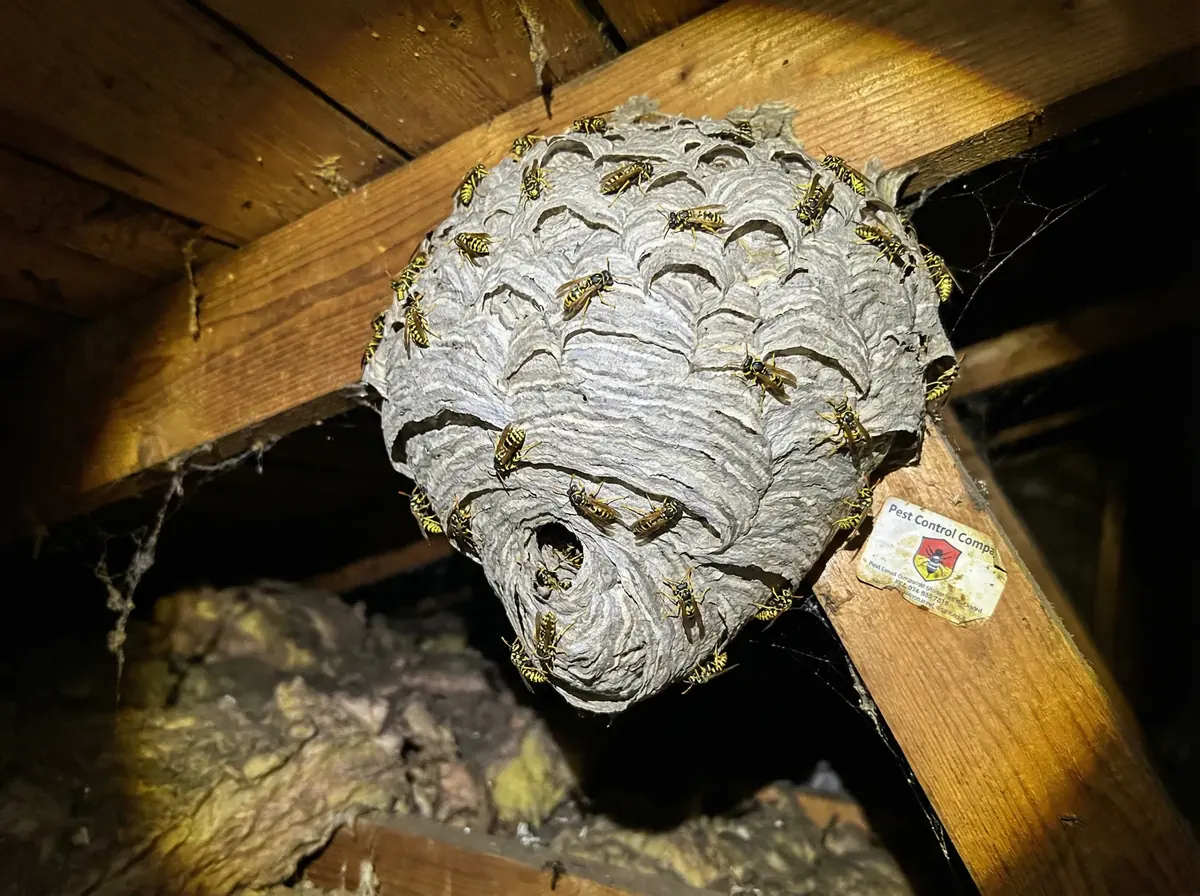
Treatment is usually more important than taking down the nest
A professional wasp treatment normally targets the nest entrance so workers carry the insecticide into the colony. The aim is to deal with live activity without asking you to reach into an eaves, loft, wall cavity or shed. Once the colony has died, the paper nest may be left in place or removed separately, depending on its position and the agreed plan.
Physical removal alone does not solve an active nest and can provoke defensive wasps. A treatment plan should make clear whether it covers treatment, access equipment, nest removal, proofing and follow-up. Availability, method and cost are confirmed for the individual property.
Summer activity is different from an old winter nest
Wasp colonies build through spring and summer and are commonly at their busiest in late summer, when workers turn more towards sweet foods. A nest that is buzzing with traffic or producing wasps indoors needs a different decision from a papery nest seen after the cold weather has arrived. Wasps abandon their nests after the season and do not reuse the same nest the following year, although a new colony may choose a nearby site.
Do not assume a quiet nest is safe to handle. Activity can be difficult to judge from the ground, especially where the entrance is hidden. Keep people away and arrange an assessment if there is any doubt.
Bees need a different and more responsible response
Bees and wasps are easy to confuse, but they should not be treated in the same way. Bees are valuable pollinators and many colonies decline naturally after the season. If the insects are furry, gathering at flowers or forming a temporary swarm, identification matters before any control is considered. A clear photograph taken from a safe distance may help, but do not approach a live cluster or block its entrance.
Where a honeybee swarm or colony is causing concern, a beekeeper or swarm collector may advise on relocation. Wigan Council states that it does not treat bees. If a colony is inside a chimney, wall or hazardous location, professional assessment is important because removal may require access work and attention to remaining comb.
What to do before a visit
Keep windows and doors closed where practical, secure food and bins, and keep children and pets away from the nest area. Do not knock the nest, seal a suspected entrance, pour liquid into a cavity or spray into a nest you can reach. DIY nest removal guides can result in multiple stings, particularly when a large colony is disturbed.
Tell the technician where you have seen insects enter and leave, whether anyone has a sting allergy, and whether the nest is near a door, play area, food-preparation space or shared access route. For rented or shared property, notify the landlord or managing agent when access, neighbouring rooms or building fabric may be involved.
Questions about wasp nest removal
What people ask before booking
Does a wasp nest have to be removed after treatment?
Not always. Treatment deals with the live colony; the empty paper nest can often remain if it is not causing a problem. Removal may be recommended where access, appearance or the building requires it, and should be agreed as part of the visit.
Can I remove an old wasp nest in winter?
An abandoned nest is normally no longer in use after the season, but you should be certain there is no live activity before touching it. If you are unsure, leave it alone and arrange professional advice rather than disturbing a hidden colony.
Will you treat bees as well as wasps?
Bees need identification and a responsible assessment, not automatic treatment. Leaving them alone or arranging relocation may be appropriate. Wigan Council does not treat bees, and a specialist beekeeper or experienced pest professional can advise where a colony is in a hazardous location.
Related help for your property
Further reading: identification, safety and local guidance
- BPCA: Pest advice for controlling Wasps (opens in a new tab)
- BPCA: Pest advice for controlling Bees (opens in a new tab)
- Wigan Council: Pests (opens in a new tab)
Pest images are illustrative, not photographs of a customer's property.