
Start with evidence, not the noise
Listen for a pattern and note the time. Repeated movement after dark, droppings, gnawing, torn insulation or food packaging, and a smell around a void are more useful together than one unexplained bang. Rats can live in roof spaces, wall cavities and under floors. BPCA also notes that scratching, gnawing and scuttling can be mistaken for squirrel activity, so sound alone is not a reliable identification.
If safe, take photographs from the loft entrance and record where signs appear. Do not crawl across insulation, handle an animal, or disturb a nest. Keep children and pets out. Droppings or urine around stored food, worktops or food containers should be treated as contamination: set affected food aside for disposal and clean carefully rather than sweeping dry material into the air.
Rat, mouse or squirrel? Useful clues and uncertainty
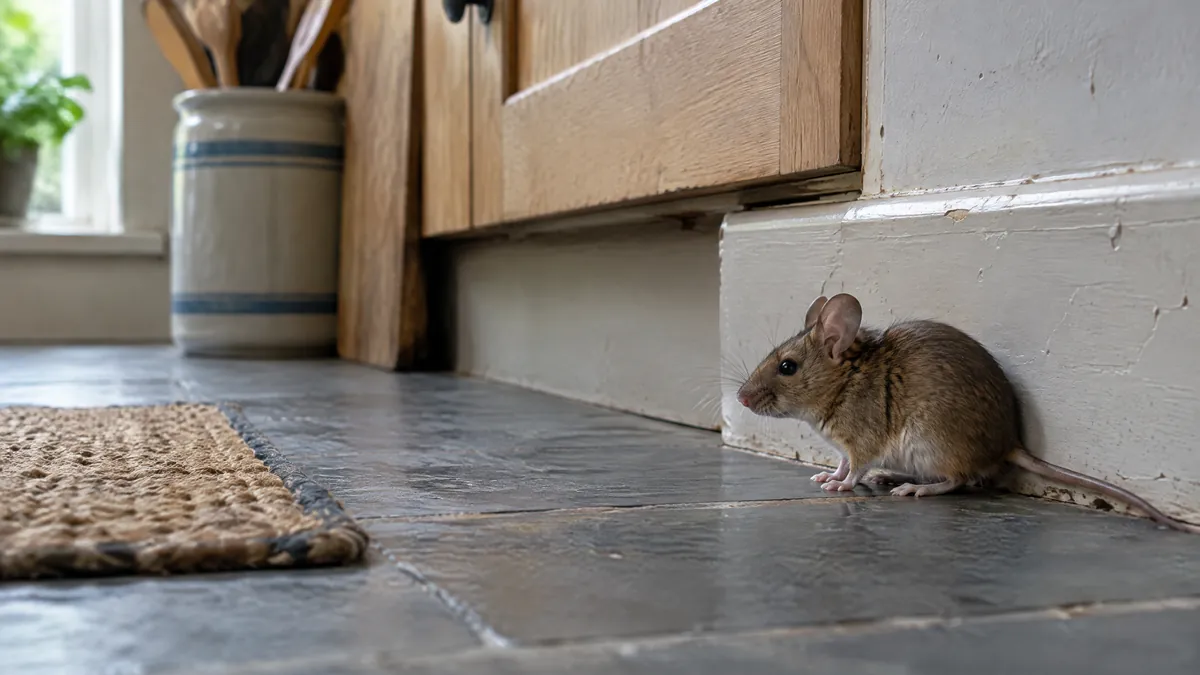
A rat is more likely to leave dark, rice-like droppings, gnawing on cables or pipe coverings, greasy rub marks, and larger damage around an entry point. Rats may move between drains, wall or floor voids and the roof. A mouse usually leaves smaller droppings and may use narrow gaps around service entries, cupboards and insulation. Size is not enough: a large mouse can be confused with a young rat.
Squirrels can produce loud, abrupt scratching or running in daylight and may bring nesting material into a loft. Look for disturbed insulation, chewed timber or an opening at the roofline, but do not assume that every roof-space noise is a squirrel. A photo of droppings, gnawing or the outside access point is more useful to an inspector than a confident guess. A professional assessment should identify the species, active route, food or water source, and whether young or non-target wildlife could be present.
- Check the outside of the property for gaps around pipes, vents, eaves, roof tiles, doors and drain connections, without reaching onto a roof or opening a cavity.
- Secure bin lids, remove fallen fruit and bird-feed spill, and keep pet food in sealed containers. Do not leave food waste accessible overnight.
- Move stored food, bedding and cardboard away from walls or the loft floor if you can do so without entering an unsafe area.
- Keep a short log of dates, times, locations and fresh signs. This helps distinguish an active route from old damage.
What not to seal or do in a hurry
Do not block the only suspected opening while an animal may still be inside. Sealing a route can trap a squirrel, separate young from a parent, or force rodents elsewhere. Do not fill a cavity with expanding foam as a first response; it may hide the route without solving access and can be chewed through. Avoid dismantling roof coverings, insulation or soffits yourself.
Do not use loose poison, glue traps or improvised snares. Rodenticide is not a species-neutral answer and can harm pets and wildlife if misused. GOV.UK advises professional help when you are unsure what may be trapped or killed, which methods are permitted, or how to use control products. Never attempt to catch and release a grey squirrel: releasing one after capture is an offence.
When the boundary becomes specialist work
Get advice before proofing if you find a nest, hear dependent young, see a bat, or cannot tell what is using the void. GOV.UK warns that bats and their roosts are protected, and places used by wildlife for shelter or breeding may also have legal protection. Active bird nests and protected species need lawful specialist handling. A grey squirrel is not a species to relocate after live capture.
For suspected rats or mice, an inspection should consider internal signs and external access together. A plan may involve targeted control, monitoring and repairs or proofing once activity has been dealt with; the scope depends on the property. If you rent, report the issue to the landlord or managing agent before structural work. Wigan Council’s published service is for council housing tenants and says it no longer treats private tenants, landlords or homeowners, so private residents should check their tenancy terms and arrange independent advice.
A safer winter checklist
Photograph signs, secure food and waste, and make the loft accessible for an inspection without disturbing suspected wildlife. Check whether movement is continuing and whether there is damage to wiring, pipes or insulation; keep clear of damaged electrics and arrange urgent repair advice where needed. Do not promise yourself that one sealed gap will end the problem: entry, harbourage and food access often need to be considered together.
Call for specialist advice when signs are fresh, repeated, inside a roof or wall void, or impossible to identify. Have the address, property type, access arrangements, photographs and any information about children, pets, tenants or protected wildlife ready. That makes it easier to decide whether the next step is rodent control, wildlife advice, or a building repair rather than an unsafe DIY treatment.
Questions about winter rodents
What people ask before booking
Can I tell if it is a rat or squirrel from scratching in the loft?
No. Both can make scratching, gnawing and scuttling sounds. Timing, droppings, gnawing, nesting material and the entry route provide better clues, but an inspection may still be needed.
Should I seal the hole as soon as I find it?
Not if an animal may still be inside, or if you have not ruled out young, bats or another protected species. Record the location and get advice first; proofing is safer once the occupant and route are understood.
Does Wigan Council treat pests at a private home?
Wigan Council says its published service is for council housing tenants and that it no longer offers pest control to private tenants, landlords or homeowners. Check the council’s current guidance and your tenancy arrangements before booking work.
Related help for your property
Further reading: identification, safety and local guidance
- BPCA: Pest advice for controlling Rats (opens in a new tab)
- GOV.UK: Pest control on your property (opens in a new tab)
- Wigan Council: Pests (opens in a new tab)
Pest images are illustrative, not photographs of a customer's property.